

Stay close enough to touch a young child whenever they are in or near water, secure wells, drains and water containers at home, put a well-fitted life jacket on children in open water, and treat swim lessons as one layer of protection, not a guarantee. Drowning can happen quickly and quietly, in as little water as a pail or a bathtub.
This guide is general information, not a substitute for training. In an emergency, call 911.
Drowning is a heavy subject for parents. This page is practical: what to do, step by step.
How serious is the risk for children?
The World Health Organization (WHO) says drowning is the fourth leading cause of death for ages 1 to 4 and the third for ages 5 to 14 worldwide (WHO drowning fact sheet, 1 May 2026), and the leading cause of death for ages 5 to 14 in the Western Pacific Region (WHO Western Pacific, 13 December 2024). A review of estimates found about 27,928 Filipino children aged 0 to 14 died from drowning between 2008 and 2017 (Guevarra et al., Children, 2021). For who is most affected and when, see Who is most at risk of drowning in the Philippines.
What is touch supervision, and how close should I be?
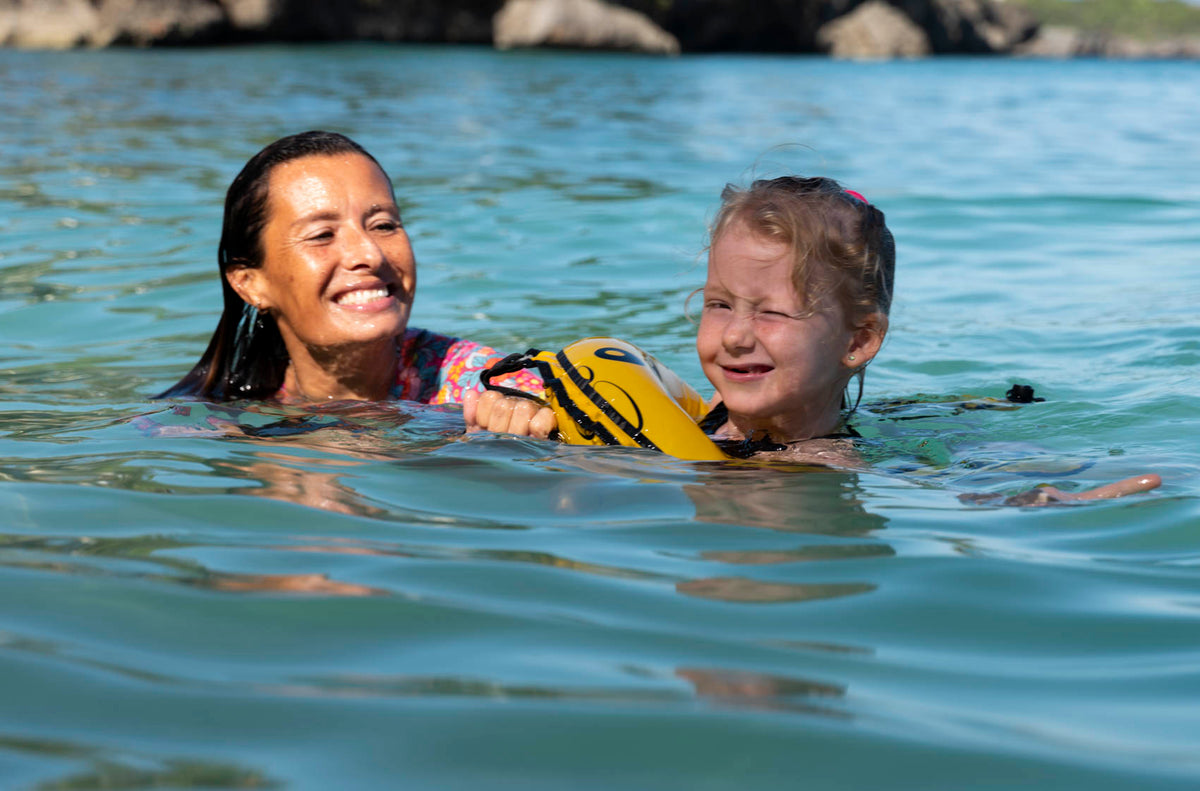
Touch supervision means an adult is close enough to reach out and touch the child, watching them with full attention. The American Academy of Pediatrics (AAP) advises staying within arm's length, providing constant "touch supervision", during bath time or swim time (AAP HealthyChildren.org, updated 18 May 2026; the term also appears in the AAP's 2019 drowning recommendations). Safe Kids Worldwide advises keeping young children and weak swimmers within arm's reach of an adult and watching without distractions (Safe Kids Worldwide, Open Water Checklist).
Why "nearby" is not enough: a Cebu Daily News report quoting the Philippine Life Saving Society (PLSS) says that, in research the group cited, children who drowned were about two metres from an adult (Cebu Daily News). We could not open the original study or confirm the report's date, so treat this as reported, not verified.
Rules that help:
- Put the phone down. One adult is the designated watcher, and hands over to another adult by name.
- Do not rely on an older child. The AAP says a young sibling should not supervise children under 6, and children should not bathe alone until at least age 6 (AAP, 2026).
- Adults who supervise should avoid alcohol or drugs (AAP, 2026).
Where do small children drown near home?
Philippine research on child drowning points to open and dug wells, creeks and open drains, walkways over water, and large water containers, with the highest risk in rural and low-income homes without piped water (Guevarra et al., Children, 2021). The AAP adds that most child drownings inside the home happen in bathtubs (AAP, 2026).
What to do:
- Wells: cover them securely. The WHO recommends covering wells and using doorway barriers and playpens (WHO, 2026).
- Creeks, canals and drains: fence or block access, and teach children never to play near them. A DOH-led pilot in northern Philippines used porch barriers, backyard fences, playpens and well covers (WHO Western Pacific, 2012; Guevarra, Franklin and Peden, IJERPH, 2021).
- Water drums and storage containers: keep covered with a lid children cannot lift. The research above names large water containers as a hazard; the lid is common-sense practice, not a finding of those studies.
Water play at home: pails, basins, tubs and inflatable pools
The AAP says to empty containers such as buckets, wading pools and coolers after each use (AAP, 2026). It adds:
- Install latches or locks on toilet seat lids.
- Consider removing the drain plug of the tub when not in use.
- Stay within touch distance for bath time and swim time.
Fill-and-play moments are fine. The rule is: an adult is there, and the water is emptied afterwards.
Do children need a life jacket?
For open water and boats, yes. The AAP says children should wear life jackets near lakes and rivers, and at pools or water parks if they lack strong swimming skills, and that inflatable toys and floaties are not safety devices because they can deflate and do not prevent drowning (AAP, 2026).

How to check the fit (Safe Kids Worldwide):
- Choose a jacket labelled for your child's weight and the water activity, with an approval label.
- Fasten all straps, buckles and zippers for a snug fit.
- Lift the jacket gently at the shoulders. If it rides up to the chin or ears, it is likely too big or the straps are loose.
- A life jacket is not a substitute for close supervision. Water wings and inflatable rings do not count as life jackets.
The AAP and Safe Kids refer to US Coast Guard approval. In the Philippines, MARINA Circular 2009-25 says life jackets used on domestic ships must be verified by MARINA and carry a MARINA hologram, with child (aged 3 to under 12) and infant (under 3) jackets marked as such (MARINA Circular 2009-25, as published by Lawyerly). That circular covers ship equipment; we did not find a Philippine approval mark for life jackets that families buy for recreational use, so ask the seller what standard a jacket meets. For travel by boat, the Philippine Coast Guard in Central Visayas said it would run pre-departure inspections on all passenger vessels during Holy Week 2025 (Cebu Daily News, 13 April 2025), and MARINA has urged operators to keep life vests accessible on board (MARINA, 6 June 2026).
Any swim aid or buoy, including products in our Kids collection, is not a life jacket and does not replace an adult within reach.
When should children learn to swim?
The AAP says children can begin swim lessons after their first birthday, depending on readiness, and describes lessons as part of a layered approach (AAP, 2026; Contemporary Pediatrics, 18 May 2026). The WHO recommends teaching school-age children basic swimming, water safety and safe rescue skills, with safety-tested curricula and set student-to-instructor ratios, and gives no single starting age (WHO, 2026). Choose instructors who teach water safety as well as strokes. Where to find lessons: Learning to swim in the Philippines.

A child who has had lessons still needs supervision. Learning to swim is one layer, alongside supervision, barriers, life jackets and CPR (AAP, 2026).
Holy Week, summer break and weekends
School holidays are a recognised risk factor in Philippine research on child drowning, along with lack of supervision, unrestricted access to water and low-income, rural households (Guevarra et al., Children, 2021). Police counts of drownings in Holy Week, and a peak in April, are in Who is most at risk of drowning in the Philippines. Holy Week in 2027 runs from Palm Sunday on 21 March to Easter Sunday on 28 March.

Before an outing:
- Choose a place with lifeguards. The DOH's Dr Maria Rosario Vergeire advised parents to choose establishments with lifeguards on duty, to check that floating devices and rescue equipment are available, and to swim only in places permitted by local authorities (DOH, as reported by Malaya; the page does not show a clear publication date, and the figures in it match Holy Week 2023).
- Check the water. Rivers can rise quickly after rain and new places have unknown depths. See Where and how drownings happen.
- Assign a watcher. In crowded places, agree who is watching which child.
- Life jackets on. The Philippine National Police chief appealed in April 2025 for the public never to leave minors unattended near water, to wear life vests, and to avoid swimming in areas without lifeguards (The Tribune, 19 April 2025; the article page did not load for us, so this is from search-result text).
- Protect from sun and heat. See Sun, heat and hydration.
Children who need extra care
The AAP's 2019 policy statement names seizure disorders, autism spectrum disorder and cardiac arrhythmias as conditions that raise drowning risk and call for additional preventive measures (Contemporary Pediatrics, 6 May 2019). As reported by The Hospitalist, the statement advises uninterrupted supervision for these children, even during baths, puts the drowning risk for children with seizure disorders at up to 10 times higher, and says wandering accounts for nearly 74% of fatal drownings among children with autism (The Hospitalist). We read both through secondary coverage, not the policy statement itself. Talk to your child's doctor about a plan for your child.
Learn CPR and basic rescue
The WHO Western Pacific office and the AAP both recommend that parents and caregivers learn CPR (WHO Western Pacific, 2024; AAP, 2026). The PLSS runs swimming, lifesaving and lifeguard courses (Guevarra, Franklin and Peden, 2021); course dates and fees are not published in the sources we reviewed, so contact the society (PLSS profile, International Life Saving Federation). Read Recognising drowning and getting help and First aid and rescue breathing basics.
A quick family checklist
- An adult is within touch distance of every young child in or near water.
- Wells covered; creeks and drains blocked; pails and basins emptied; drums covered.
- Life jackets fitted for open water and boats.
- Lifeguard on duty at the beach or resort.
- Swim lessons from about age one if the child is ready, with supervision always.
- An adult who knows CPR and the emergency number, 911.
More: How to prevent drowning.
Related RESTUBE products


Sources
- World Health Organization. Drowning fact sheet, 1 May 2026. https://www.who.int/news-room/fact-sheets/detail/drowning
- WHO Western Pacific. Media release, Manila, 13 December 2024. https://www.who.int/samoa/news/detail-wpro/13-12-2024-drowning-deaths-decline-in-the-western-pacific--but-urgent-action-is-still-needed ; Preventing drowning in the Philippines, 4 November 2012. https://www.who.int/micronesia/news/detail-wpro/04-11-2012-preventing-drowning-in-the-philippines
- American Academy of Pediatrics. Water Safety and Young Children, HealthyChildren.org, updated 18 May 2026. https://www.healthychildren.org/English/safety-prevention/at-play/Pages/Water-Safety-And-Young-Children.aspx ; Updated Recommendations to Prevent Drowning in Children, 15 March 2019. https://healthychildren.org/English/news/Pages/Updated-Recommendations-to-Prevent-Drowning-in-Children.aspx
- Contemporary Pediatrics. AAP updates drowning prevention guidance, 18 May 2026. https://www.contemporarypediatrics.com/view/aap-updates-drowning-prevention-guidance ; Drowning prevention calls for multiple safety measures, 6 May 2019. https://www.contemporarypediatrics.com/view/drowning-prevention-calls-multiple-safety-measures
- The Hospitalist. Policy statement on drowning highlights high-risk groups (on Denny SA, et al. Prevention of Drowning. AAP policy statement, Pediatrics, 15 March 2019). https://blogs.the-hospitalist.org/content/policy-statement-drowning-highlights-high-risk-groups
- Safe Kids Worldwide. Open Water Checklist. https://www.safekids.org/tip/open-water-checklist-pdf ; Ask an Expert: How to find the right life jacket? https://www.safekids.org/blog/ask-expert-how-find-right-life-jacket
- Guevarra JP, Peden AE, et al. Preventing Child Drowning in the Philippines: The Need to Address the Determinants of Health. Children 8(1):29, 2021. https://doi.org/10.3390/children8010029
- Guevarra JP, Franklin RC, Peden AE. "I Want to See a Drowning-Free Philippines". Int J Environ Res Public Health 18(2):381, 2021. https://doi.org/10.3390/ijerph18020381
- Cebu Daily News. PLSS research on child drowning and supervision (date not shown). https://cebudailynews.inquirer.net/?p=29183 ; Holy Week 2025 travel tips: PCG-7 heightens security at seaports, 13 April 2025. https://cebudailynews.inquirer.net/632641/holy-week-2025-travel-tips-pcg-7-heightens-security-at-seaports
- MARINA. Circular 2009-25, as published by Lawyerly. https://dev.lawyerly.ph/laws/49927 ; MARINA calls for strict compliance with life-saving appliance requirements, 6 June 2026. https://marina.gov.ph/2026/06/06/marina-calls-for-strict-compliance-with-life-saving-appliance-requirements/
- Malaya. DOH: pick resorts, beaches with lifeguards (date not shown). https://malaya.com.ph/news/doh-pick-resorts-beaches-with-lifeguards
- Daily Tribune. Drowning claims 15 during Holy Week, 19 April 2025. https://tribune.net.ph/2025/04/19/drowning-claims-15-during-holy-week
- International Life Saving Federation. Philippine Life Saving Society profile. https://www.ilsf.org/organisation/philippines/
Last reviewed: 12 October 2026.